Abstract:
Novel carboranylcontaining silicone-based elastomers are linear carboranylmethylorganosiloxanes with a molecular mass up to 250000. They are obtained by copolycondensation of 1,7 – bis-(hydroxydimethylsilylmethyl)-m-carborane (I) [1] with a bis-(N-dimethyl-N'-phenylureido)dimethyl- (methylphenyl, diphenyl or methylvinyl) silane (II) with slow addition of (I) to the solution of (II) in chlorobenzene at a temperature of -10 ± 5 ° C. The reaction proceeds according to the scheme:
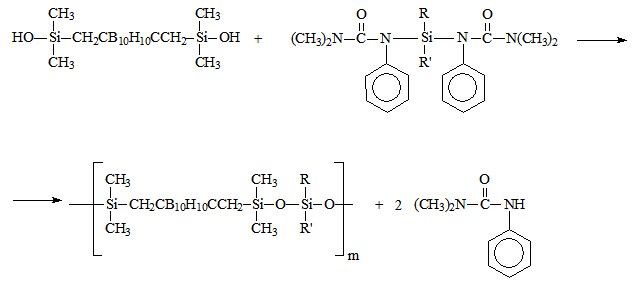
where R and R 'are similar or different CH3, C6H5, CH2=CH.
The optimal properties has a polymer with the structure containing 66 mol. % of dimethylsiloxane, 33 mol. % of methylphenylsiloxane or diphenylsiloxane units and 1 mol. % of methylvinylsiloxane units.
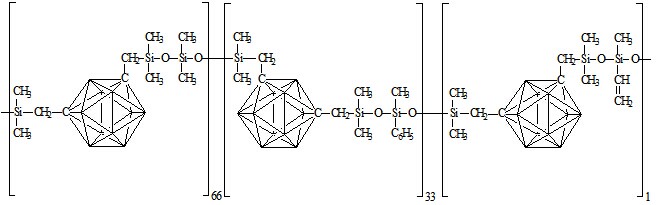
This amorphous polymer has Tg = - 38°C or -25°C, respectively, and can be vulcanized during ordinary peroxide vulcanization. In carboranylmethylorganosiloxane elastomers the linking system SiCH2-Ccarborane is highly resistant to electrophilic, nucleophilic reagents and atmospheric moisture, unlike to previously described bond Si-Ccarborane, which splits easily by these reagents.
Carboranylmethylorganosiloxane elastomers are readily mixed with fillers and other ingredients on a two roll mill and in Banbery mixer. As vulcanizing agents are used benzoyl peroxide or dicumyl peroxide in an amount of 1-2.5 weight parts, as the reinforcing fillers - silicon dioxide or magnesium silicate in an amount of 30 weight parts and as antioxidants - iron oxide in an amount of 2.5 weight parts on 100 weight parts of elastomer.
The mixture of these ingredients, containing benzoyl peroxide, after forming at 50°C is vulcanized at 100°C for 20 minutes under slight pressure and then at 125°C for 20 minutes followed by post- vulcanization at 150-200°C for 24 hours. For a mixture containing dicumyl peroxide, the vulcanization cycle is as follows: 125°C - 20 minutes and 150°C - 20 minutes, followed by post-vulcanization.
Vulcanizates containing silicone dioxide have higher initial mechanical properties than the vulcanizates containing magnesium silicate, but at 315°C lose these properties to a greater extent (Table 1).
Table 1. Mechanical properties of vulcanizates at 25°C after heat ageing at 315°C.
Ageing time, h | Young's modulus kg/cm2 | Ultimate tensile strength, kg/cm2 | Relative elongation ,% |
Vulcanizate, containing 30 weight parts of silicon dioxide |
0 | 38.5 | 43.9 | 101 |
25 | 65.7 | 31.9 | 63 |
50 | 79.6 | 30.5 | 57 |
75 | 100,0 | 35.0 | 52 |
150 | 128.0 | 38.7 | 47 |
300 | 240.0 | 40.5 | 32 |
Vulcanizate, containing 30 weight parts of magnesium silicate |
0 | 26.3 | 14.3 | 112 |
23 | 29.5 | 16.9 | 95 |
50 | 32.6 | 17.8 | 82 |
75 | 32.8 | 18.6 | 73 |
150 | 37.9 | 19.5 | 65 |
300 | 106.0 | 47.9 | 44 |
*Polymer (33% mol. of diphenyl units) -100 weight parts; iron oxide – 2,5 weight parts; dicumyl peroxide – 2,5 weight parts
The dependence of the mechanical properties of the vulcanizate from the temperature is given in Table 2, which shows that when the temperature close to the glass transition temperature of the polymer the vulcanizate modulus and its ultimate tensile strength increases and the tension set elongation decreases.
Table 2. The temperature dependence of the mechanical properties of vulcanizate*
Temperature, °С | Young's modulus kg/cm2 | Ultimate tensile strength, kg/cm2 | Relative elongation ,% |
300 | 36.0 | 4.8 | 16 |
260 | 36.8 | 8.5 | 32 |
200 | 40.8 | 11.9 | 133 |
25 | 36.0 | 37.3 | 133 |
-20 | 178.0 | 40.0 | 185 |
-30 | 269.0 | 106.7 | 58 |
-40 | 9833.0 | 148.0 | 23 |
*Polymer (33% mol. of methylphenyl units) -100 weight parts; silicon dioxide – 30 weight parts; dicumyl peroxide – 2,5 weight parts; iron oxide – 2,5 weight parts
To determine the low temperature properties of vulcanizates was used method (A) at which the sample was stretched to ¾ of its relative elongation, frozen and then heated with heating rate of 1 degree per minute, noting the temperature at which the sample length is reduced by 10% (TR-10) and 70% (TR-70).
TR-10 equal to -39°C is correlated with the brittle temperature of vulcanizates and TR-70, which is equal to -26°C, with a low-temperature residual compression.
Vulcanizates of carboranylmethylorganosiloxane elastomers are resistant to ignition. Thus the oxygen index of vulcanizate containing 30 weight parts of silicon dioxide is equal to 63 (for comparison, the oxygen index of silicone rubber is 30 - 37).
The solvents resistance of carboranylmethylorganosiloxane elastomer vulcanizate is shown in Table 3.
Table 3. The solvents resistance of vulcanizate*
Solvent | Young's modulus, kg/cm2 | Ultimate tensile strength, kg/cm2
| Relative elongation ,% | Swelling, % |
_____ | 36.0 | 36.8 | 132 | ____ |
Water | 37.6 | 40.5 | 112 | 0.42 |
Ethanol | 35.7 | 39.8 | 117 | 2.17 |
Methanol | 34.6 | 40.7 | 112 | 1.63 |
Toluene | 35.0 | 40.0 | 112 | 1.58 |
Acetone | 37.3 | 38.4 | 102 | 47.8 |
Xylene | 40.2 | 39.8 | 102 | 150.0 |
CCI4 | 36.2 | 45.8 | 127 | 145.0. |
Standard hydrocarbon fuel | 30.2 | 45.4 | 125 | 113.0 |
*Polymer (33% mol. of methylphenyl units) -100 weight parts; silicon dioxide – 30 weight parts; dicumyl peroxide – 2,5 weight parts; iron oxide – 2,5 weight parts. Test method (A): samples were immersed in solvent for 7 days at room temperature.
Vulcanizates of carboranylmethylorganosiloxane elastomers can be widely used as heat-resistant coatings.
[1] V.N.Kalinin, B.A.Izmaylov, A.A. Kazantzev, V.D.Myakushev, A.A.Zhdanov, L.I.Zakharkin// J.Organometal. Chem. 216 (1981) P.295-320.
___________________________________
Biography:
Personal
Born March 25, 1938 ( Dushanbe, USSR)
Marital Status Married, 1 children
Home Address Academician Anokchin Str., 12(3)-252, Moscow 117602, Russia.
Home telfax 007495 430-98-17
Work Address 28 Vavilov Str., A.N.Nesmeyanov Institute of Organo-Element Compounds (INEOS), Russian Academy of Sciences, GSP-1 Moscow 119991, Russia.
Tel 007 499-1356075
Fax 007 499-1355085
E-mail izmailov38@yandex.ru
Educational Background
Graduated from the Moscow Lomonosov Institute of Fine Chemical Technology (MITCHT) in 1962
Scientific Degrees ant Ranks
1967 Moscow M.V. Lomonosov Institute of Fine Chemical Technology--Ph.D. in Polymer Chemistry
1989 Scientific Council for Synthetic Materials (Presidium of RAS)--Dr. Sci. in Organo-Element Compounds
1993 USSR Correspondence Institute of Textile and Light Industry (Moscow)--Professor in Organic, Physical, Colloid and Analytical Chemistry
Experience
1962-1965 A.N.Nesmeyanov Institute of Organo-Element Compounds of the Russian Academy of Sciences--Post-graduate student
1965 Research Associate
1965-1969 Redkinsk Experimental Plant Of Chemical Industry--Head of Laboratory for Organosilicon Polymers
1969-1975 Kalinin Polytechnic Institute--Docent in Plastic Technology
1975-1989 Scientific Council for Synthetic Materials (Presidium of RAS), Moscow--Senior Research Worker
1982-1989 Institute of Synthetic Materials of RAS, Moscow--Leading Research Worker
1989-1995 USSR Correspondence Institute of Textile and Light Industry, Moscow--Head of Chair in Organic, Physical, Colloid and Analytical Chemistry
1995-2010 A.N.Kosygin State Textile University(MGTU), Moscow--Head of Chair in Analytical, Physical and Colloid Chemistry
2005-until now A.N.Nesmeyanov Institute of Organo-Element Compounds (INEOS), Russian Academy of Sciences--Leading research Worker of Laboratory for Heterochain Polymers
Scientific and Dissertation Councils
1995-2011 Member of MGTU Scientific Council
1995-2010 Member of MGTU Dissertation Council
1995-Until now Member of GNICHTEOS Dissertation Council
Leadership
Supervisor of 9 post-graduated students
Awards
1993 Soros Personal Grant
2003,2007 Prizewinner of MGTU Concurs in field of science
2009 Diploma of Procter & Gamble Concurs “Innovation Initiative 2009” in the field of surface modification (Moscow, Russia)
2010 Gold Medal “Arkhimed-2010” for a work “Light Accumulated and Luminescent Silicon Materials” (Moscow, Russia)
2010 Gold Medal and Grand-Prix for a work “Light Accumulated and Luminescent Silicon Materials” (Iassy, Rumania)
2010 Gold Medal and Diploma for a work “Light Accumulated and Luminescent Silicon Materials” (Sevastopol, Ukraine)
Research Experience
Synthesis and Investigation of Polymers and Copolymers of Different Microstructures and Configurations Linears and Branches, Star-Like and Comb-Like Macromolecules with HydrophilicHydrophobic and other Properties.
Silicon Surface Modification of Materials.
Research Publications
705 papers and 70 USSR and Russian Patents in the period from 1962 to 2011.
18 Scientific Results have Innovated in Plants of USSR Chemical Industry
Scientific interests – chemistry of organoelement compounds, organic chemistry, physical chemistry of materials surface, chemical modification of materials surface and processing of polymers and composites.
Project (as a project leader a participant)
Time | Nature and Source of the Project | Total amount of Budget | Number of Participants | Position and Responsibilities of the Applicant |
2011-2013 | Project of Russian Foundation for Basic Research (RFBR) | $ 60000 | 10 | Head of Project |
2010-2011 | Research Project “INEOS RAS”-“Samsung” Electronics Co. Ltd | $ 100000 | 10 | Head of Project |
2011-2012 | Research Project “INEOS RAS”-“Samsung” Electronics Co. Ltd | $ 100000 | 10 | Head of Project |
 Prof. Dr. Boris A. Izmaylov